

How Long Does an Eviction Take in Queens, New York?
FREE CONSULTATION Call us now at (718) 514-7900 If you are a landlord dealing with a tenant who has stopped...
Learn More
Navigating property abandonment laws in NY requires an intricate balance between recovering real estate assets and respecting tenant protections. In New York, a landlord cannot simply conclude that a property has been vacated because rent payments have ceased or because a tenant has left personal items behind. Instead, strict statutory guidelines dictate how property owners must act. Failing to follow these exact steps can expose landlords to severe administrative liabilities, expensive property lawsuits, and criminal unlawful eviction charges. Understanding property abandonment laws in NY is vital for property managers, owners, and residential investors throughout Queens and the greater New York City area.
Key Takeaways
Property abandonment laws in NY govern the exact legal protocols a property owner must execute when an apartment appears entirely vacant. Landlords are explicitly barred from making unilateral assumptions regarding a tenant’s permanent departure based solely on nonpayment or missing items. Instead, New York State jurisprudence requires landlords to establish absolute proof of a tenant’s intent to abandon through definitive actions and clear documentation before recovering physical control of the real estate.
Property abandonment occurs when a tenant definitively vacates a rental unit without notifying the landlord and has zero intent to return or fulfill their remaining lease obligations. Establishing this specific intent is a complex legal challenge under New York landlord-tenant regulations.
A quiet, empty unit does not automatically satisfy the legal threshold for abandonment. For example, a resident might be undergoing an extended hospital stay, fulfilling a military deployment, traveling for business, or temporarily residing elsewhere while facing a personal crisis. Consequently, property owners must collect concrete, objective evidence before altering the status of the tenancy.
Even when every indicator is present simultaneously, New York regulations generally require a landlord to secure a formal court order or explicit legal confirmation before executing cleanouts or changing entry locks.
Understanding property abandonment laws in NY requires recognizing that statutory tenant protections remain fully active even when a rental unit appears entirely deserted. New York civil courts heavily scrutinize any self-help measures executed by landlords, prioritizing tenant possessory rights above a swift turnover process.
New York housing courts routinely require landlords to establish explicit legal authority before modifying entry mechanisms, disposing of tenant property, or executing a new lease agreement. As a direct consequence, engaging in self-help actions exposes property owners to triple damages, steep financial assessments, and structural civil liability.
Because every tenancy situation presents unique factual variations, maintaining a meticulous, chronological record of evidence often serves as the deciding factor when proving abandonment in court.
Many real estate investors mistakenly believe that an empty residential space automatically terminates a tenancy. However, New York state statutes provide comprehensive, ironclad protections for current occupants, regardless of their payment status.
Bypassing the formal court system and executing an unauthorized lock change can immediately trigger:
Therefore, property owners must systematically avoid making assumptions based on visual impressions alone. Utilizing a formal, state-sanctioned eviction or abandonment process remains the only legally sound path forward.
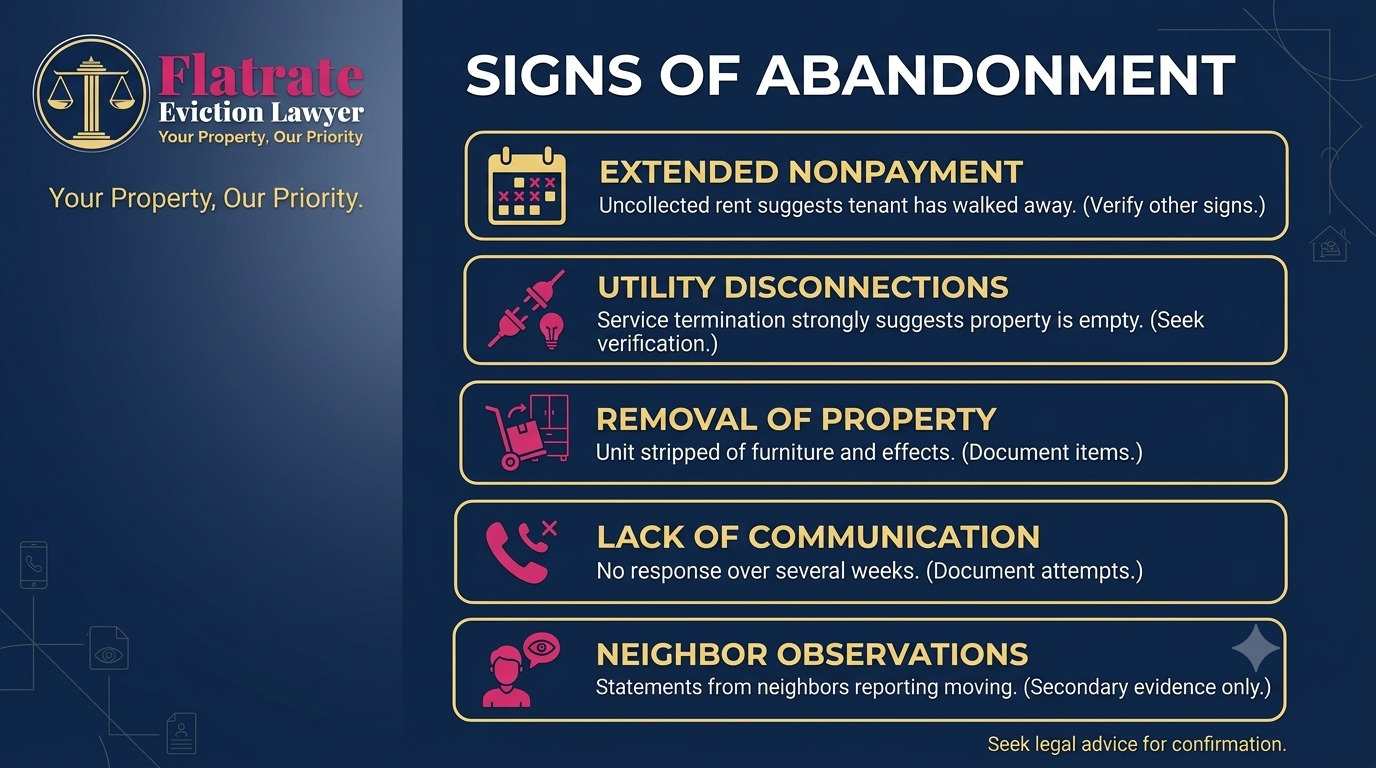
Long periods of uncollected rent frequently indicate that a tenant has permanently walked away from their lease agreement. However, financial delinquency by itself does not establish clear legal abandonment under New York state precedents.
The termination of active utility services strongly suggests that a resident no longer physically occupies the premises. Nevertheless, additional corroborating evidence is standardly required to confirm the tenant’s intent to vacate permanently.
When a unit is stripped of furniture, mattresses, and personal effects, the probability of legal abandonment increases significantly. Still, landlords must proceed with extreme caution and document the exact state of the remaining items.
Repeated, well-documented attempts to contact a tenant over several weeks without receiving any response heavily reinforce an abandonment claim during summary proceedings.
Affidavits or formal statements from neighboring tenants reporting moving activity provide strong secondary evidence. While highly useful in housing court, these observations must strictly serve as support for primary financial and utility documentation.
Here is a crucial reality that most property management companies overlook: New York State law does not contain a codified, single timeline regarding the storage of abandoned personal property. However, standard judicial precedent across Queens and NYC housing courts strongly favors landlords who show deep regulatory restraint. If you clear out a unit prematurely, a tenant can resurface and sue you for the “conversion” of their property, alleging you destroyed priceless heirlooms or essential documents. To insulate yourself entirely from these predatory claims, always transport left-behind belongings to a secure storage space for a minimum of 30 days. Send a certified itemized inventory log directly to the tenant’s last known address. If they fail to claim the items within that 30-day window, you can legally dispose of or sell the items to mitigate uncollected rent balances.
Managing an apparently deserted rental property requires extreme caution, meticulous record-keeping, and strict adherence to New York real estate statutes. Moving forward without expert validation can turn a simple lease abandonment into a legal and financial nightmare. Property owners must secure their investments by using proven legal channels rather than unverified shortcuts.
If you suspect a tenant has permanently vacated your rental unit, do not risk executing self-help lock changes or disposal maneuvers. Protect your real estate assets by contacting the specialized team at Flatrate Eviction Lawyer to navigate property abandonment laws in NY. Call our Queens office at (718) 514-7900 today to schedule a comprehensive case evaluation and safely recover your property.
A: Abandonment under property abandonment laws in NY requires a combination of physical absence and clear intent. Landlords must prove that the tenant left without intending to return, supported by utility cutoffs, empty rooms, and no contact.
A: No, a landlord cannot change locks without proper legal authority or an official court warrant. Doing so violates NYC administrative codes, exposing the property owner to immediate unlawful eviction lawsuits and financial penalties.
A: Landlords should carefully document, inventory, and securely store all remaining items for at least 30 days. Written notices must be sent to the tenant detailing how and where to reclaim their personal belongings before they are disposed of.
A: No, uncollected rent is merely one supporting factor and does not automatically establish legal abandonment. Tenants may be temporarily absent, meaning landlords must still gather additional physical evidence or pursue a formal court order.
A: A landlord should contact an attorney the moment a tenant stops paying rent and becomes completely unresponsive. Promptly retaining legal counsel ensures that inspections, notifications, and court filings adhere strictly to New York housing laws.
Our experts regularly author articles and create other forms of publication and commentary on important legal matters and policy developments. Here are some of the latest publications from our legal experts.