


How Long Does an Eviction Take in Queens, New York?
FREE CONSULTATION Call us now at (718) 514-7900 If you are a landlord dealing with a tenant who has stopped...
Learn More
Managing a rental unit is usually straightforward: signed paperwork, regular payments, and scheduled moveouts. But things get messy fast when the lease calendar runs out, and the occupant refuses to pack their bags. Landlords across Queens face this exact scenario every single month, leaving property owners scratching their heads over what the legal system calls a holdover tenancy. Is the occupant a standard criminal trespasser? Do you waive your rights if you accept their next check?
At Flatrate Eviction Lawyer, we actively help property owners navigate these high-stakes rental risks before a single wrong move creates an unwanted contract. Accepting money without a written strategy can lock you into a nightmare cycle. This practical guide breaks down exactly what is holdover tenancy and how you can legally regain total control of your residential or commercial property.
Key Takeaways
What is holdover tenancy depends heavily on whether an owner permits the ongoing occupation or treats it as an unapproved contract breach. A holdover tenancy occurs when a tenant continues to occupy the rental property after their fixed-term lease has officially expired, without the landlord’s explicit renewal or permission.
The core legal component here is the complete expiration of the right. Unlike a standard lease violation—where an occupant breaks a specific operational rule like keeping an unauthorized pet during an active contract—a holdover in lease scenario happens exclusively after the original document terminates. The tenant possessed a legitimate right to be inside your kitchen yesterday. Today, that right has completely lapsed, but their furniture remains inside the unit.
[Fixed-Term Lease Active] ──> [Lease Expires] ──> [Tenant Remains Without Consent] = Holdover Status
The reality on the ground is that holdover status is never a one-size-fits-all legal category. It splits down the middle into two distinct classifications based entirely on how you react:
Imagine an apartment lease ends on December 31st. You hand-delivered a clear non-renewal notice back in November. Yet, on January 1st, their vehicle is parked in the driveway, and their television is blaring in the living room. They did not break into the building with a crowbar; they simply refused to pack.
For a Queens property owner, this means the occupant is sitting in legal purgatory. They are not technically a common prowler because you handed them the original keys. But they no longer possess the legal protections of a standard leaseholder unless you make an administrative blunder and treat them like one. You are entering a complex legal landscape where your very next move dictates your rights for the next six months.
The absolute most common question our team receives is: “Can I just call the local precinct to clear out my property?” The short answer is almost always no. Correctly identifying the dividing line between a civil holdover status and criminal trespassing is what keeps you from getting hit with a massive wrongful eviction lawsuit.
| Feature | Holdover Tenant | Trespasser |
| Initial Entry | Legal (had a valid lease) | Illegal (never had permission) |
| Current Consent | Expired (or pending) | None |
| Eviction Process | Requires a civil court | Often handled by the police immediately |
| Rent Payment | May offer rent (landlord caution needed) | Does not pay rent |
| Legal Label | Tenancy at Sufferance | Criminal / Civil Intruder |
While it certainly feels like they are invading your space, the civil court system views the situation through a completely different lens. A trespasser is an individual who never possessed permission to cross your property line. A holdover tenant, conversely, crossed the threshold legally with an active contract.
Because you originally handed over the keys and granted legal possession of the real estate, they retain a specific standing known as a tenancy at sufferance. Local police officers will not drag them out because they cannot verify lease terms or oral modifications on a street corner. They will tell you it is a civil matter that belongs in front of a real housing judge.
Why do occupants stay past their welcome? It is rarely a malicious plot to steal a house. The primary driver of these situations is a gap in housing continuity, meaning the individual simply has nowhere else to move their belongings. While some cases involve professional tenants gaming the system, most stem from poor planning, sudden financial shifts, or extremely tight rental markets. Here’s the part most property owners won’t tell you about: how these situations actually develop on the ground:
Often, an individual holding over is stuck between two locations. Their next apartment might not be ready until the 5th of the month, but their current lease with you ended on the 31st. Or perhaps their moving company canceled at the last second. In these specific scenarios, the holdover in the lease is accidental and temporary. A direct, firm conversation can often resolve the timeline without spending thousands on a formal lawsuit.
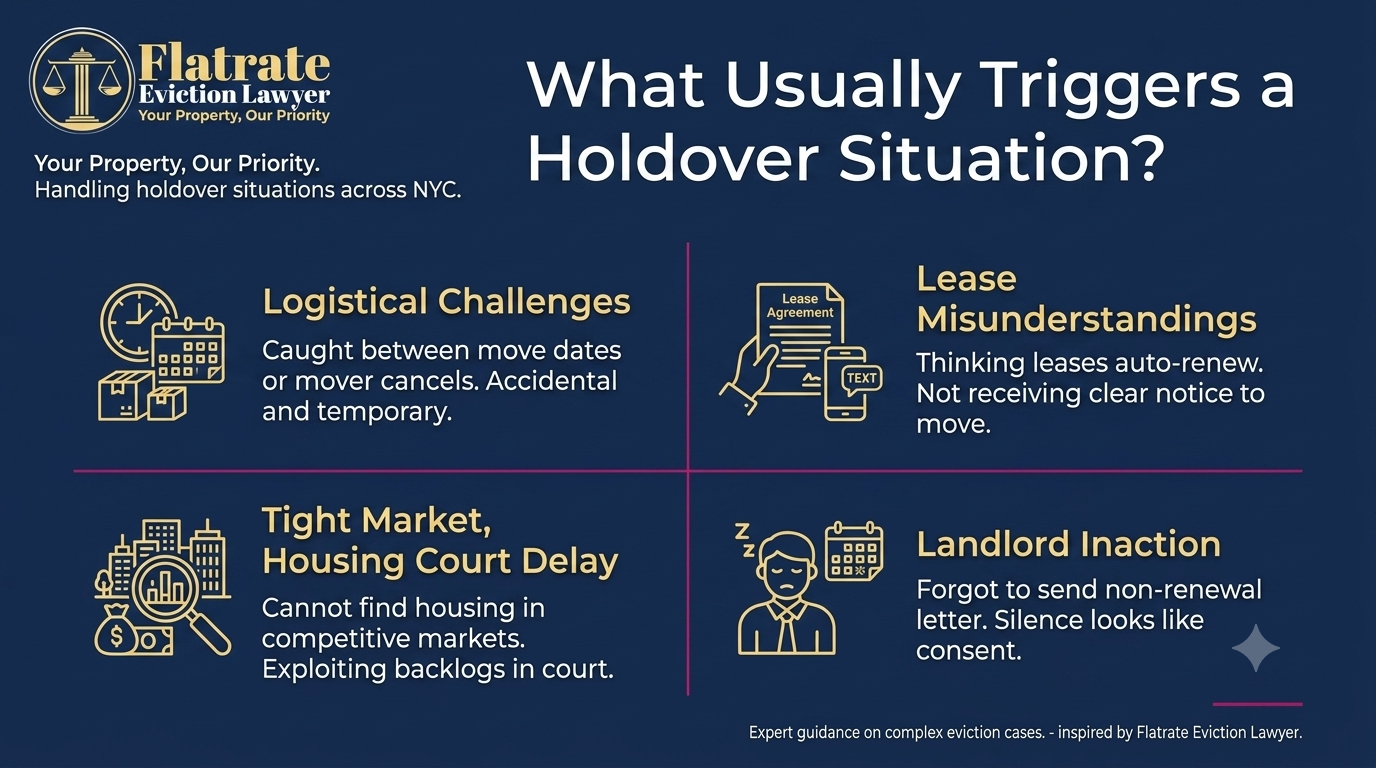
Sometimes, occupants genuinely misunderstand the terms of their paperwork. They might assume an apartment lease automatically rolls over into a month-to-month agreement if they do not receive a reminder text. Or they assume a standard rent grace period extends their actual move-out window. This is why checking what a notice period is in your specific state is absolutely vital to your case. If you did not issue a clear, written demand to vacate, the occupant can argue they were left in the dark.
In hyper-competitive rental markets, an individual might stay simply because they cannot find an affordable alternative. A holdover tenant in California or New York, for example, might exploit complex tenant protection acts to delay their departure, knowing the housing court calendar is backed up for months. They are effectively converting your private investment property into an emergency shelter because they refuse to face the open market.
This is a massive administrative trap. If you completely forget to issue a formal non-renewal letter, or if you ignore the expiration date because you are busy, the occupant will assume silence equals consent. This administrative slip-up often automatically converts the arrangement into a legal month-to-month periodic tenancy, handing them full legal protections all over again.
When you are staring down an occupant who refuses to pack, you have exactly three actionable operational paths to resolve the standoff. You can formalize the arrangement, execute a legal eviction, or orchestrate a cash-for-keys settlement. Your choice hinges entirely on whether you want the monthly cash flow or the physical keys back.
┌─── Option 1: Formalize (New Lease / Month-to-Month)
│
[Holdover Situation] ├─── Option 2: Evict (Formal Notice to Quit ──> Court Filing)
│
└─── Option 3: Negotiate (Cash-for-Keys Agreement)
If the occupant has historically paid on time, taken excellent care of the property, and you do not have a new applicant waiting, you can choose to let them stay. By accepting a check for the upcoming month, you typically transform the tenancy holding over into a standard month-to-month periodic tenancy.
If you need the unit cleared because you are selling the property or remodeling, you must follow the strict letter of the law. Do not accept a single dollar of rent. We cannot stress this enough to property owners. Accepting cash for any period after the expiration date instantly sabotages your legal standing.
Many experienced real estate investors find it significantly cheaper to offer a direct buyout. This is a negotiated settlement where you hand the occupant a set amount of cash in exchange for them clearing out their belongings immediately.
Navigating what a holdover proceeding is requires strict adherence to statutory rules. If you skip a single step or miss a filing window, the housing judge will throw your case out of court, forcing you to start the entire process over from day one.
Until you accept a new check, the occupant remains a tenant at sufferance. While that sounds intense, it is the exact statutory term required for your court filings. It means they exist on your property solely through your tolerance and are subject to immediate removal. The exact second you cash their check, they transform into a periodic tenant with full eviction defense rights.
Local ordinances dictate exactly how much warning you must serve an occupant before filing paperwork at the courthouse clerk’s window:
Even if someone refuses to leave your house, you cannot take the law into your own hands. You must serve notice. Learn the types of eviction notices to ensure you utilize the proper form for a holdover, which is completely different from a standard non-payment notice.
Property owners possess the explicit right to pursue financial damages. In many jurisdictions, you can sue for holdover rent penalties. For example, Maryland’s landlord-tenant statutes permit courts to award double the standard monthly rent for the exact duration of the holdover period to discourage occupants from stalling.
However, occupants still retain basic human rights. Even during a holdover, they are legally entitled to a safe, habitable environment. You cannot cut the electricity, terminate the water service, or remove the front door. These actions constitute a constructive eviction and are completely illegal under state codes. If you pull these stunts, the occupant can sue you for harassment and win thousands in damages, regardless of their lease status.
Self-help eviction is the technical term for taking matters into your own hands without a court order. It is an absolute civilian dealbreaker in every single state.
Engaging in these tactics can trigger massive civil fines and potential criminal charges. If you are asking what to do if someone won’t leave your house, the solution is never vigilante action. It is always the strategic utilization of the civil court system.
If you end up standing inside a housing courtroom, the entire burden of proof rests squarely on your shoulders. The judge will closely evaluate the evidence needed in a holdover case before granting a warrant of eviction, so your files must be flawless.
You must bring the original, signed fixed-term lease agreement to the witness stand. You need to point directly to the clause outlining the exact Start Date and End Date. This concrete document proves to the court that the contractual relationship has concluded and no ongoing occupancy rights exist.
You must prove the occupant received timely, unambiguous orders to vacate the premises. Bring copies of the non-renewal notice or the specific eviction notice you served. Crucially, attach the formal affidavit of service or certified mail receipt. A judge will instantly dismiss your petition if you cannot prove delivery.
Present your official bank ledgers to demonstrate that you completely refused any money after the contract expired. If the occupant attempted an automated electronic transfer, provide documentation showing you rejected the funds or isolated them in a non-rent escrow account labeled for “use and occupancy” only. This clean paper trail proves you never consented to an extension.
Print out every single relevant text message, email, and paper letter. If the occupant wrote, “I know my lease ended last week, I’m just waiting on my new place,” you have secured a critical piece of evidence. This admission proves they are fully aware of their holding over situation and eliminates the defense that they thought the lease had renewed.
Some holdovers get incredibly complicated. For example, if the occupant is currently subletting vs subleasing the unit to strangers without your written consent after the lease terminated, you must bring photos or online listings documenting the unauthorized use. This reinforces to the judge exactly why you need immediate physical possession returned to you.
To prevent these legal standoffs from draining your rental income, you must run a tight operational ship. These three protective rules keep you ahead of the game:
So, what is a holdover tenancy? It is that precarious legal gap between a lease ending and a tenant actually packing their bags. For Queens property owners, it represents a high-stakes moment where operational discipline matters significantly more than raw emotion. If you want the occupant to stay, draft a brand-new lease extension right away. If you want them out of your house, refuse their money and execute the formal legal paperwork immediately.
Dealing with a holding over situation can feel incredibly stressful, but you can navigate it cleanly with the right procedural blueprint. Do not let an uncooperative occupant freeze your rental business income. Instead, take a decisive step forward to protect your real estate portfolio.
Contact Flatrate Eviction Lawyer at (718) 514-7900 today to find out exactly what is holdover tenancy rules for your property, clear out your operational risks, and secure your property’s long-term profitability.
A: Yes. If a landlord mistakenly accepts a partial rent payment after the expiration date, fails to serve the required statutory notice, or attempts a self-help lockout, the judge will dismiss the case. Occupants can also win temporary hardship stays if they meet local vulnerability criteria.
A: It is not a criminal offense, but it constitutes a direct breach of a civil contract. The individual is financially liable for ongoing usage fees and damages, but they are not classified as a criminal trespasser until a civil judge signs a formal warrant of removal.
The landlord must hold the security deposit until the unit is completely vacated. You can legally deduct unpaid use and occupancy fees along with physical property damage, provided you issue a certified rent late fee and deposit accounting statement within the local statutory deadline.
A: Yes, absolutely. To evict an individual with an expired contract, you must execute the state’s formal civil eviction process through the housing court system. Taking matters into your own hands via illegal lockouts is strictly prohibited.
Due to local housing court backlogs across Queens and Manhattan, the process typically takes anywhere from 3 to 6 months. Property owners should carefully review how many lease violations are present before eviction to see if there are faster grounds for legal removal.
Disclaimer: The information provided in this post is intended for general informational and educational purposes only. It should not be construed as legal, accounting, or tax advice. For guidance specific to your situation, we recommend consulting with a qualified professional in the relevant field before taking any action based on the content provided.
Our experts regularly author articles and create other forms of publication and commentary on important legal matters and policy developments. Here are some of the latest publications from our legal experts.