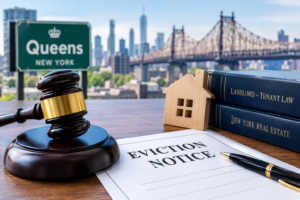


How Long Does an Eviction Take in Queens, New York?
FREE CONSULTATION Call us now at (718) 514-7900 If you are a landlord dealing with a tenant who has stopped...
Learn More
In New York, landlords are required to provide a written 14-day notice for unpaid rent cases or a Notice to Quit when addressing lease violations. However, landlords cannot personally serve these legal documents. Instead, service must be completed by an unrelated adult or a professional process server to meet the requirements of the New York Courts Unified Court System.
Navigating property rentals requires strict compliance with state housing laws. Landlords must issue formal demands before initiating any legal action against non-paying or violating occupants.
Key Takeaways
Proper delivery of an eviction notice in New York is the mandatory foundation for regaining legal possession of a rental unit. Property owners frequently make mistakes by trying to serve these documents personally, which violates state procedural laws. Hiring an authorized process server guarantees your paperwork aligns with New York Courts Unified Court System regulations, preventing immediate dismissal by a housing court judge.
Financial Deficits: Failing to supply monthly rent payments constitutes the most frequent trigger for property reclamation actions. Landlords must provide a written notice alerting the occupant to the specific debt before any petition hits the court docket.
Contractual Violations: Causing structural property damage, maintaining unauthorized pets, or sub-leasing without permission violates explicit lease terms. Property owners must issue warnings detailing the issue and providing a clear window for the tenant to fix the problem.
Tenancy Expirations: Occupants remaining past their formal lease conclusion become holdovers under state law. Terminating these arrangements requires specific windows based directly on how long the individual has occupied the space.
| Eviction Scenario | Mandatory Notice Period | Required Delivery Steps |
| Nonpayment of Rent | 14 Calendar Days | Personal, Substitute, or Conspicuous delivery + Certified Mail follow-up. |
| Lease Agreement Infractions | 10-Day Notice to Cure | Physical delivery by an independent party plus standard mail duplication. |
| Holdover (Tenancy < 1 Year) | 30 Calendar Days | Delivery managed by a licensed process server outside the immediate dispute. |
| Holdover (Tenancy 1–2 Years) | 60 Calendar Days | Full statutory delivery with formal tracking receipts retained for verification. |
| Holdover (Tenancy 2+ Years) | 90 Calendar Days | Strict multi-step delivery executed at the designated Queens real estate asset. |

The housing court system in Queens operates under heavy volume, and judges show zero tolerance for DIY delivery mistakes. If a landlord delivers a demand themselves, the defense attorney will get the case thrown out immediately during the first hearing. Save yourself months of delays by hiring a professional process server who understands the exact nuances of local service rules.
If your occupant fails to correct a violation or clear an outstanding rent balance after the notice period concludes, you must transition to formal litigation. The reality on the ground is that changing locks or cutting off electrical lines will expose you to severe structural damage and criminal penalties.
Follow these steps to proceed safely:
Protect your investment by downloading our comprehensive New York eviction notice guide today.
A: You must hire an independent adult over eighteen or a professional process server to deliver the written notice. The server must hand it to the tenant, leave it with a suitable person at the unit, or post it on the door, followed by sending copies through both certified and regular first-class mail.
A: The initial notice period ranges from 14 days for nonpayment up to 90 days for long-term holdovers whose tenancies exceed two years. If the tenant ignores the demand, the subsequent court petition and hearing process can add several months to the overall property recovery timeline.
A: No, landlords cannot skip the notice phase under any circumstances before initiating a summary proceeding in housing court. Skipping this step or attempting self-help methods like lock changes violates real property actions and proceedings laws, which can lead to civil penalties.
A: The tenant has the legal right to resolve the cited issue by paying the rent balance, fixing the contract breach, or moving out. If the tenant ignores the timeline and remains in the unit, the property owner can officially file a case in the local housing court.
A: A landlord can draft the text of the document personally, but it must contain exact statutory language and itemized, accurate figures. Any missing identifying details, uncredited balances, or minor calculation mistakes will cause the judge to dismiss the case, forcing you to start over.
Our experts regularly author articles and create other forms of publication and commentary on important legal matters and policy developments. Here are some of the latest publications from our legal experts.